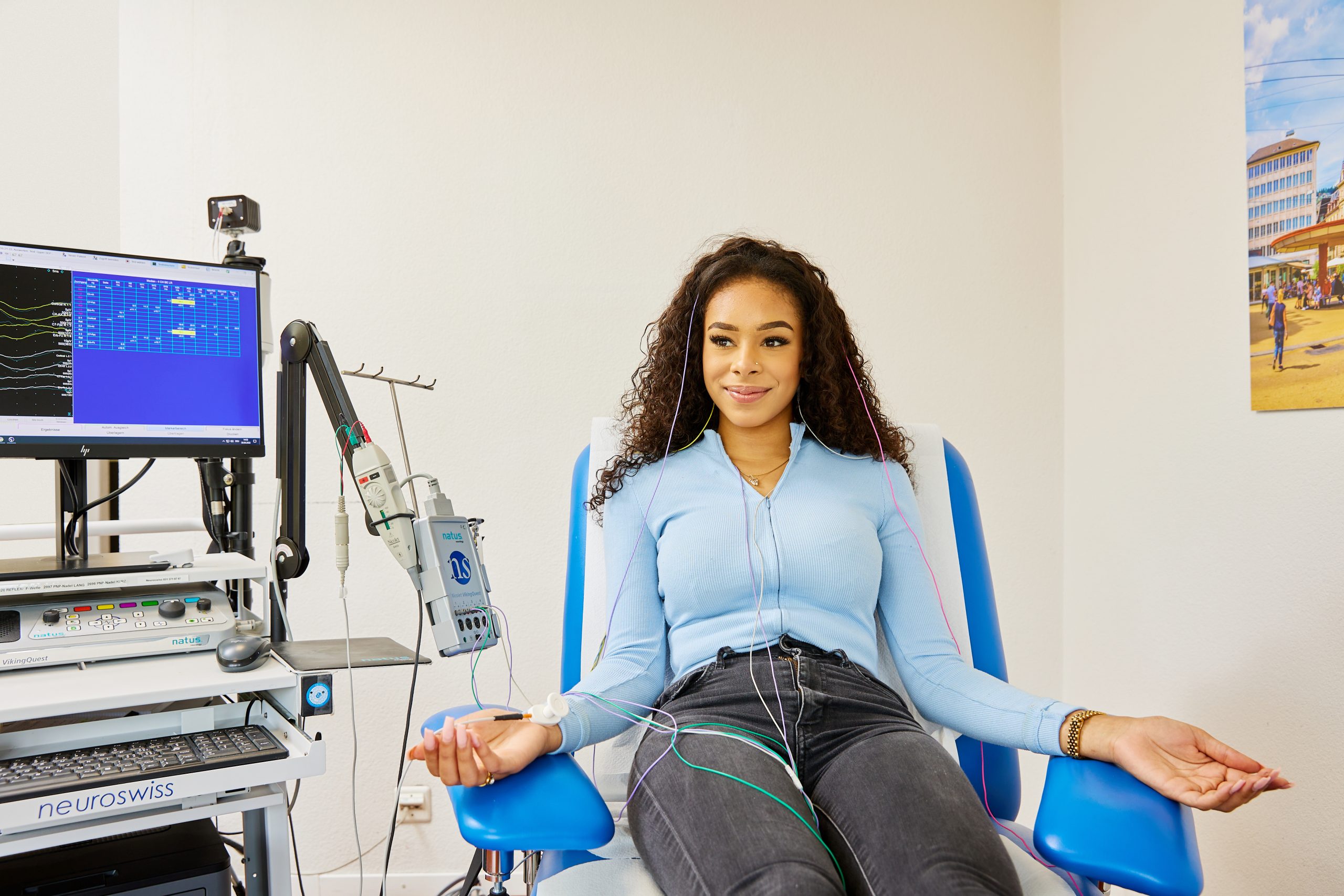
Measurements are made to record electrical muscle activity using thin, non-traumatic needles, for assessment of muscle diseases as well as nerve and spinal cord disorders.
The electrical activity of the muscle is transmitted via the needle through a wire to the EMG device, where the signal is amplified and made visible on a screen and audible through a loudspeaker. The shape of the recorded muscle potentials allows conclusions to be drawn about muscle function, which is why this examination is well suited for assessing muscle diseases (e.g., symptoms such as muscle spasms, muscle twitching, muscle pain, muscle atrophy and possibly associated diseases such as muscle inflammation, muscular dystrophy, amyotrophic lateral sclerosis).
However, EMG is much more commonly used for indirect assessment of nerve function. In a completely relaxed healthy muscle, no activity is heard, although it is always ready for action. However, if nerve fibers die, a muscle that is always ready for action will eventually begin to discharge on its own. Spontaneous muscle discharges are therefore a sign of nerve damage. These discharges are usually so small that they are only visible on the EMG. Sometimes, however, they become so strong that they can also be seen as an involuntary muscle twitch.
The purpose of examining the muscles is therefore to be able to detect damage to the nerve supplying it. This is why, for example, an examination of a muscle in the arm or leg can be used to draw conclusions about damage to the nerve in the spine, e.g. due to a herniated disc. This means it is not necessary to examine the spine itself.