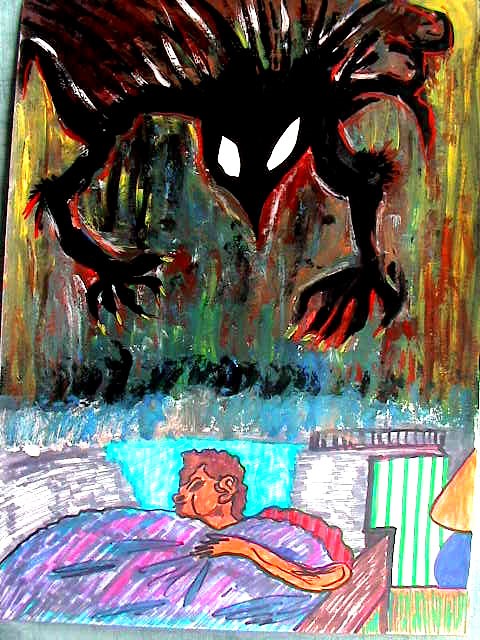
Dreams are called nightmares if they occupy the dreamer for a long time and are filled with fearful scenarios. As dream recall is enhanced upon awakening, disturbed sleep supposedly leads to more frequent dreaming. Dreams in REM sleep are more vivid and detailed than dreams in non-REM sleep, which are often vaguely remembered. If dreams are very close to reality when falling asleep or waking up, they are called “hypnagogic hallucinations”; these occur mainly in narcolepsy but also occur rarely in healthy persons. Nightmares also often occur after psychological trauma or in anxiety disorders, e.g. in the context of post-traumatic stress disorder.
A specific type of nightmares, mostly with content involving fighting, is accompanied by strong movements or screaming. In these situations the dream is acted out and visible to an observer, because the muscle paralysis which otherwise occurs in REM sleep has been lost for pathological reasons. When making movements such as extending the arms and legs the dreamer may injure themselves or another person in the bed. This so-called dream-sleep behaviour disorder may be a symptom of incipient dementia or Parkinson’s Disease. However, similar behaviours also occur in chronic alcoholism and in narcolepsy cataplexy.