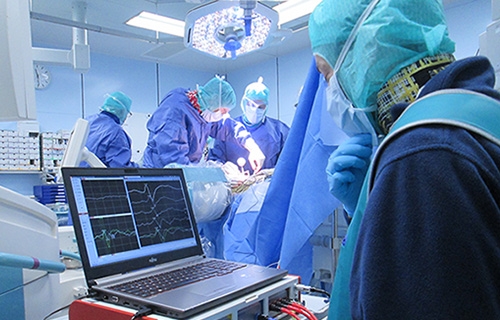
Patients benefit from neuromonitoring during surgeries where there is a risk of injury to parts of the nervous system. This service is commonly provided by neurologists who work alongside spinal surgeons, but it is also used in other surgical specialties (neurosurgery, vascular surgery, orthopedic surgery and procedures performed by otolaryngologists and urologists).
In any surgical procedure involving the spine there is some risk to the spinal cord or the nerve roots originating from it. Somatosensory evoked potentials (SEPs) can be measured by neurologists during surgery to continuously monitor nerve function, for example, in the spine. This involves stimulation of parts of the body below the surgical area and discharges at the head above the surgical area. After a measurement of the baseline values before the operation, comparative measurements are then taken continuously during the operation. If there is no change, it can be assumed that the spinal cord or nerve roots have not been damaged. If there are changes in the values, surgical corrections can often be made during the operation, e.g. by changing the chosen surgical access route or removing previously placed implants that are causing interference.
Motor evoked potentials (MEPs) are also often used for neuromonitoring. Here the sequence is reversed, so the motor center is stimulated from the surface of the head and conducted to below the surgical area on the hands or legs. This allows direct monitoring of motor function during surgery.